The Golden Angle: How Sunflowers Pack Seeds
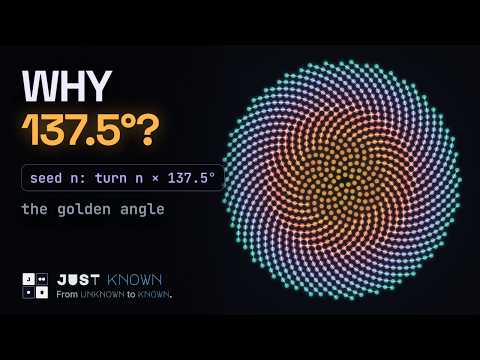
Place each seed a little further round than the last, always by the same angle, and push it out by the square root of its number. At 137.5 degrees you get a sunflower; a tenth of a degree off, gaps open; a simple fraction of a turn, and the seeds line up in spokes. We build Vogel's sunflower model from one seed, turn the knob through fractions of a turn, see why angles close to fractions leave gaps, meet continued fractions and the golden ratio (the number hardest to match with fractions), count the spirals (Fibonacci numbers), measure how evenly the seeds pack, and simulate how a plant finds the angle with no ruler: each new bud forms where there's the most room. Plus a long history, from Bonnet to Turing, the golden-ratio claims that don't hold up, and where the same trick is used today.
Chapters
- 0:00 Intro
- 0:50 A flower full of flowers
- 1:20 One rule
- 1:52 Turn the knob
- 2:21 Close to a fraction
- 2:53 The hardest number to pin down
- 3:39 Counting spirals
- 4:19 Room for every seed
- 4:47 How a plant finds it
- 5:49 A long history
- 6:22 Not everything is golden
- 7:03 Where else
- 7:37 Draw it yourself
- 8:02 Recap and next
Cheat sheet
- Vogel's model (1979): seed n sits at angle n × α and distance c × √n from the center; √n gives every seed the same area
- The golden ratio φ = (1 + √5)/2 = 1.6180340; the golden angle = 360°/φ² = 137.50776° = 137° 30′ 28″ (the turn split in the golden ratio: 222.49° ÷ 137.51° = φ)
- A fraction p/q of a turn makes q straight spokes; 137.0° makes 21 bent spokes, 138.2° makes 13 arms
- The golden angle's best fractions of a turn: 1/2, 1/3, 2/5, 3/8, 5/13, 8/21, 13/34, 21/55 … (ratios of Fibonacci numbers)
- Continued fractions: π = [3; 7, 15, 1, 292, …] (so 22/7 and 355/113 come close); φ = [1; 1, 1, 1, …]
- Spirals in a 1,000-seed head: 8/13 near the center, then 13/21, 21/34, 34/55, and 55/89 at the rim
- Closest pair of seeds at the golden angle: 0.84 of honeycomb spacing; at 137.3° or 137.7°, below 0.6
Sources
- Vogel, A better way to construct the sunflower head (Mathematical Biosciences, 1979)
- Douady and Couder, Phyllotaxis as a physical self-organized growth process (Physical Review Letters, 1992)
- Reinhardt et al., Regulation of phyllotaxis by polar auxin transport (Nature, 2003)
- Swinton et al., Novel Fibonacci and non-Fibonacci structure in the sunflower (Royal Society Open Science, 2016)
- Noone, Torrilhon and Mitsos, Heliostat field optimization: a new computationally efficient model and biomimetic layout (Solar Energy, 2012)
- Livio, The Golden Ratio (2002)
- Phyllotaxis
Transcript
Take a seed. Turn a little, and place the next one. Turn the same amount again, and place another. Keep going, pushing the older seeds outward, and a sunflower appears. The turn is one hundred thirty-seven and a half degrees.
Change it by a tenth of a degree, and gaps open up. Change it to a simple fraction of a turn, and the seeds line up in spokes. By the end of this video, you'll know why this one angle packs seeds so well, why the spirals come in Fibonacci numbers, how a plant finds the angle without measuring anything, and which golden-ratio claims are myths.
This is Just Known. From unknown, to known. Beauty of Math, episode seven: the golden angle, how sunflowers pack seeds. A sunflower's face isn't one flower. It's hundreds of tiny florets, often more than a thousand, and each one in the middle can become a seed.
They're packed edge to edge, with no gaps and hardly any wasted space. Look closely, and you see spirals: some curving one way, others curving the other way. Pine cones have them. So do pineapples, daisies, and artichokes. A plant has no ruler, and no plan of the whole head.
So how does it pack them so well? In nineteen seventy-nine, Helmut Vogel wrote down a simple model. Number the seeds: one, two, three, and so on. Seed number n sits at an angle of n times one hundred thirty-seven and a half degrees, and at a distance from the center that grows with the square root of n. Why a square root?
The area of a disc grows with the square of its radius. So if the radius grows as the square root of n, every new seed adds the same amount of area. Every seed gets the same space. Place a thousand seeds this way, and you get a sunflower head. So what's special about one hundred thirty-seven and a half?
Let's turn the knob. At half a turn, each seed lands opposite the last one, and they form two straight arms. A third of a turn gives three spokes. A quarter turn, four. Two fifths of a turn gives five.
Any simple fraction of a turn does this: after a few seeds, they land right back on the same lines, and the space between the spokes is wasted. So the turn shouldn't be a fraction at all. But an angle that isn't a fraction can still be close to one. At one hundred thirty-seven degrees, the seeds almost repeat every twenty-one, so they form twenty-one bent spokes with gaps between them. At one hundred thirty-eight point two, they follow thirteen arms.
The golden angle is different. Near the center, it looks a bit like a third of a turn. Then two fifths. Then three eighths, then five thirteenths. Each fraction is closer than the last, but none of them fits for long.
So no spokes settle in, and no gaps open. How well can a number be matched by fractions? Write it as a continued fraction: a whole number, plus one over another whole number, plus one over another, and so on. A big number in that chain means a fraction fits very well. Pi starts three, seven, fifteen, one, two hundred ninety-two.
That's why twenty-two sevenths, and three hundred fifty-five over one hundred thirteen, come so close. The golden ratio, about one point six one eight, is all ones. One, one, one, forever. No number is harder to match with fractions. And the golden angle is just the full turn split in the golden ratio: the bigger part is one point six one eight times the smaller part, and the smaller part is one hundred thirty-seven and a half degrees.
Now count the spirals. Near the rim of a big head, there are fifty-five curving one way, and eighty-nine the other. Further in, thirty-four and fifty-five. Then twenty-one and thirty-four. Near the center, eight and thirteen.
These are Fibonacci numbers: one, one, two, three, five, eight, thirteen, each one the sum of the two before. Divide each by the one before, and the answers close in on the golden ratio. The spirals are those fractions, made visible: seeds that sit next to each other are a Fibonacci number apart. That's why the golden angle packs so well. For each seed, measure how close its nearest neighbour is, compared with a perfect honeycomb.
At one hundred thirty-seven and a half degrees, even the closest pair anywhere in the head is more than eight tenths of the ideal spacing, from the center out to the rim. Move just two tenths of a degree away, and somewhere in the head the seeds crowd, while space goes empty somewhere else. The closest pair drops below six tenths. But a plant can't measure angles, and it doesn't have to. At a growing shoot tip, new buds form one at a time, and each one appears where there's the most room, as far as it can get from the buds just before it.
That idea goes back to Wilhelm Hofmeister, in eighteen sixty-eight. Today, the leading explanation is a growth hormone called auxin: existing buds soak it up from around them, so it can only build up in the gaps, and that's where the next bud starts. Simulate that rule. Buds appear on a ring, drift outward, and push each other away. Let them drift fast at first, then slower, as the tip grows.
From every start we tried, the angle between buds settles near one hundred thirty-seven and a half degrees, all by itself. In nineteen ninety-two, Stéphane Douady and Yves Couder saw the same spirals form with drops of magnetic fluid in a dish of oil. A sunflower head builds its pattern the other way round, from the rim inward, but each new floret still starts in a gap between older ones. People noticed the pattern long before anyone explained it. In the seventeen fifties, Charles Bonnet described leaves spiraling around stems.
Around eighteen thirty, Karl Schimper and Alexander Braun found leaves sitting a half, a third, two fifths or three eighths of a turn apart: Fibonacci fractions. In eighteen thirty-seven, the Bravais brothers worked out the angle those fractions close in on: one hundred thirty-seven degrees, thirty minutes, twenty-eight seconds. And in the last years of his life, Alan Turing was working on why plants grow Fibonacci spirals. The golden ratio has a reputation, and not all of it is earned. Even sunflowers break the rule.
In twenty twelve, a citizen science project collected six hundred fifty-seven sunflowers and counted their spirals. Nearly one count in five didn't fit the Fibonacci pattern, often missing by one, like fifty-four instead of fifty-five. And a few heads followed a cousin sequence, the Lucas numbers: forty-seven and seventy-six. And many famous claims don't hold up. A nautilus shell does grow in a spiral, but it widens about three times per turn, not the six point eight five of a golden spiral.
And claims about the Parthenon or the Mona Lisa depend on where you choose to draw the rectangle. The same trick works wherever you need to spread points evenly. Wrap the golden angle around a sphere, and you get points spread almost evenly over a globe, used to sample directions in computer graphics, and proposed as grids over the whole Earth for weather models. Engineers have even designed solar power plants with their mirrors on a sunflower spiral: on paper, the same mirrors fit into about sixteen percent less land. And you'll find the spirals in pine cones, pineapples, and Romanesco broccoli, as neighbouring Fibonacci numbers, like five and eight, or eight and thirteen.
You can grow your own sunflower in about ten lines. Pick the angle: one hundred thirty-seven point five oh eight degrees. For each seed n, go out the square root of n, turn n times the angle, and draw a dot. Do that a thousand times. Then change the angle to a hundred and twenty, or one hundred thirty-seven point three, and see what happens.
The code is in the description. Let's recap. Place each seed a golden angle further round, and push it out by the square root of its number. Simple fractions of a turn make spokes, and angles close to fractions leave gaps. The golden angle splits the turn in the golden ratio, the number hardest to match with fractions, so the seeds never line up.
The spirals you count are Fibonacci numbers. And a plant finds the angle by putting each new bud where there's the most room. Next time: drop balls through rows of pins, and a bell curve appears. The Galton board. This is Just Known.
From unknown, to known.
Note: every seed pattern, count and plot is computed from Vogel's model or the bud simulation. Pictures marked "illustration" (the florets, the plant icons, the auxin field, the magnetic drops, the shell and temple outlines, the solar mirrors, the sunflower grid) are schematic; the grid of counted heads illustrates the 2012 project's finding and is not its data.
Narration voice generated with Google Gemini text-to-speech.