Times Tables on a Circle: Hidden Hearts
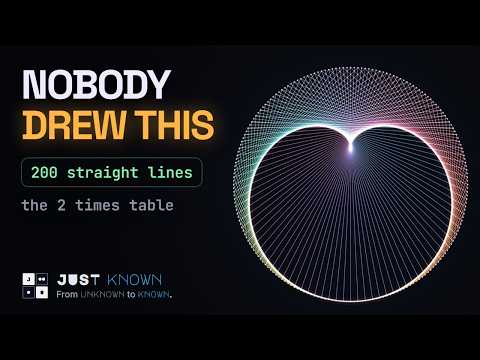
Put 200 points around a circle and join each number to its double. Every line is straight, and yet a heart appears that nobody drew: a cardioid. We build it from ten points and clock arithmetic (Gauss, 1801), see why the lines must make a heart (each one swings like a seesaw about a pivot a third of the way along), roll one coin around another, and turn the knob: times 3 makes a kidney, and times m makes m − 1 cusps. Then the same curves in light bouncing in a coffee cup, as two musical notes, in strange big tables like ×99, ×68 and ×102, and inside the Mandelbrot set.
Chapters
- 0:00 Intro
- 0:46 The rules
- 1:23 Clock arithmetic
- 1:48 More points
- 2:13 Why a heart?
- 2:49 Two coins
- 3:20 Turn the knob
- 3:53 Light in a cup
- 4:31 Hearing the hearts
- 5:02 In between
- 5:43 A famous heart
- 6:26 Where you'll meet it
- 6:56 Draw it yourself
- 7:22 Recap and next
Cheat sheet
- Times table on a circle: N points, join each n to m·n, counting round past N like a clock (modular arithmetic)
- ×2 makes a cardioid (1 cusp), ×3 a nephroid (2 cusps), ×m makes m − 1 cusps
- The ×2 line touches the heart a third of the way along, from its slow end: (2P + Q)/3
- A coin rolled round an equal coin traces the cardioid, and spins twice on the way
- A light on the rim of a round mirror: the bounced rays are the ×2 lines. Parallel light: the ×3 lines
- The ×m curve is two spinning circles, speeds 1 and m: traced 220 times a second it sounds 220 Hz and m × 220 Hz
- On 200 points, ×67 draws the same lines as ×3, because 3 × 67 = 201
- The Mandelbrot set's main body: c = e^(it)/2 − e^(2it)/4, an exact cardioid
Sources
- Gauss, MacTutor
- Modular arithmetic, Britannica
- Cardioid, MacTutor
- Nephroid, MacTutor
- Epicycloid, MathWorld
- Coin rotation paradox
- Cardioids in coffee cups, Chalkdust
- Mandelbrot set
- Mary Everest Boole, MacTutor
- Further watching: Mathologer, "Times Tables, Mandelbrot and the Heart of Mathematics" (2015)
Transcript
Put two hundred points around a circle, and number them. Now take the two times table. Join one to two, two to four, three to six, and keep going, all the way round. Every line is perfectly straight, and yet a heart appears that nobody drew. Change the times table, and the heart turns into a kidney, and then into flowers with more and more petals.
By the end of this video, you'll know why these shapes appear, why you've seen one in a coffee cup, and where the same heart hides in one of the most famous pictures in mathematics.
This is Just Known. From unknown, to known. Beauty of Math, episode three: times tables on a circle, hidden hearts. Here are the rules, with just ten points first. Number them zero to nine, around the circle.
Take each number, double it, and draw a straight line from the number to its double. One goes to two. Two goes to four. Three to six. Four to eight.
Five times two is ten, but there's no ten on our circle. So keep counting round, past nine, and you land back on zero. Six goes to twelve, which lands on two. Seven goes to fourteen, which lands on four. It's what a clock does: four hours after ten o'clock is two o'clock, not fourteen.
Mathematicians call this modular arithmetic. You only keep the remainder. Fourteen divided by ten is one, with four left over, so fourteen lands on four. Carl Friedrich Gauss set out its rules, and the notation we still use, in eighteen oh one, in a book he published at twenty-four. Today it's everywhere: in clocks, in calendars, and in the encryption that keeps your messages private.
With ten points, it's just a tangle. So add more. Twenty points. Fifty. A hundred.
Two hundred. The lines crowd together, and a shape appears along their edge: a curve that none of the lines actually draws. Each line just touches it, at a single point, and carries on. A curve made this way is called an envelope. This one is called a cardioid, from the Greek word for heart.
But why should straight lines make a heart at all? Follow a single line as its first end slides around the circle. Its other end is always at double, so it has to move twice as fast. That makes the line swing, like a seesaw. At every moment, one point on the line isn't moving sideways at all: the pivot.
It sits a third of the way along, closer to the slow end. That pivot is exactly where the line touches the heart. Follow the pivot all the way round, and it traces the cardioid. That's the whole secret: one end at speed one, the other at speed two. There's another way to draw the same heart.
Take two coins of the same size. Hold one still, and roll the other all the way around it, without slipping. Follow one point on the rolling coin's rim, and it traces a cardioid. And here's a surprise: on its trip around, the rolling coin spins around twice, not once. In the last episode, we drew shapes with spinning circles.
The heart needs only two: a big one turning once, and one half its size, turning twice as fast. Speed one and speed two: the same numbers as the two times table. Turn the knob. The three times table makes a kidney, with two sharp points, called cusps. Four makes three cusps.
Five makes four. Every table adds one more: times m makes m minus one cusps. And each one is a rolling-coin curve too. For the kidney, roll a coin half the size. For three cusps, a coin a third the size.
The smaller the coin, the more times the traced point touches down on the way round, and each touch is a cusp. Here's where you may have seen one. Make the circle a mirror, and put a light on its rim, at zero. Every ray bounces off the inside, and the bounced rays are exactly the lines of the two times table. Where they crowd together, the light piles up into a bright cardioid.
Now move the light far away, like the sun. The bounced rays follow the three times table, and the bright curve becomes a nephroid, from the Greek for kidney. That's the bright curve you see on milk or coffee in a cup on a sunny day: half a nephroid, with its point in the middle. A curve of light like this is called a caustic. As always in this series, a shape can be a sound.
Trace the heart two hundred and twenty times a second, sending its sideways motion to your left speaker and its up and down motion to your right. You hear two notes at once: one from the circle at speed one, and one from the circle at speed two, an octave higher. The three times table adds a note three times higher instead: an octave and a fifth. Four makes two octaves. Each times table plays the next harmonic, the same notes a guitar string makes.
That's what you hear in this episode's Short. Nothing says the multiplier has to be a whole number. Two and a half works too: some lines simply end between the points. As the multiplier slides from two to three, the heart melts smoothly into the kidney. Big multipliers make patterns of their own.
Times ninety-nine weaves a grid. Times sixty-eight hides a little heart inside a ring. Times one hundred and two hides two hearts at once: one for the even numbers, and one upside down for the odd ones. And times sixty-seven draws the kidney again, because three times sixty-seven is two hundred and one, which wraps round to one. The two tables undo each other, so they share every line.
Now, perhaps the most famous heart in mathematics. This is the Mandelbrot set. It comes from one simple rule, repeated: square a number, then add a constant. The set is every constant that keeps the numbers from running off to infinity. Its main body is an exact cardioid, drawn by the same two spinning circles: one at speed one, and one half its size at speed two.
That speed two comes from the squaring. Square a point on a circle, and its angle doubles. So joining every point on a circle to its square draws the two times table again, and its heart is exactly the shape of the Mandelbrot set's main body. We'll explore the Mandelbrot set properly in the next episode. You'll meet these curves in more places than you'd expect.
The classic microphone singers use on stage is called a cardioid microphone. Plot how well it hears in each direction, and ideally you get this exact heart: full sensitivity in front, and almost nothing from behind. Light in cups and rings draws them as caustics. And string artists make them with nails and thread. Curve stitching, as it's called, was championed as a way to teach children geometry by Mary Everest Boole, more than a hundred years ago.
You can draw these yourself in a few lines of code. Put the points around a circle. For each number n, draw a line from n to m times n. You don't even need the remainder: the angle just keeps going round, past a full turn, all by itself. Set m to two for the heart, and three for the kidney.
Then try two and a half, or fifty-one, and change the number of points. The code is in the description. Let's recap. Join every number on a circle to its double, wrapping round like a clock. The lines are straight, but their edge is a heart: a cardioid.
It appears because one end of each line moves twice as fast as the other, so every line swings about a pivot, and the pivots trace the heart. Times m makes m minus one cusps, and light bouncing in a ring draws the heart and the kidney. Next time, we zoom into one of the most famous shapes in mathematics: the Mandelbrot set, where one tiny rule makes endless detail. This is Just Known. From unknown, to known.
Note: every curve on screen is computed from its math. Pictures marked "illustration" (the clock, calendar and padlock, the coffee cup, the microphone, the nail board) are schematic.
Narration voice generated with Google Gemini text-to-speech.